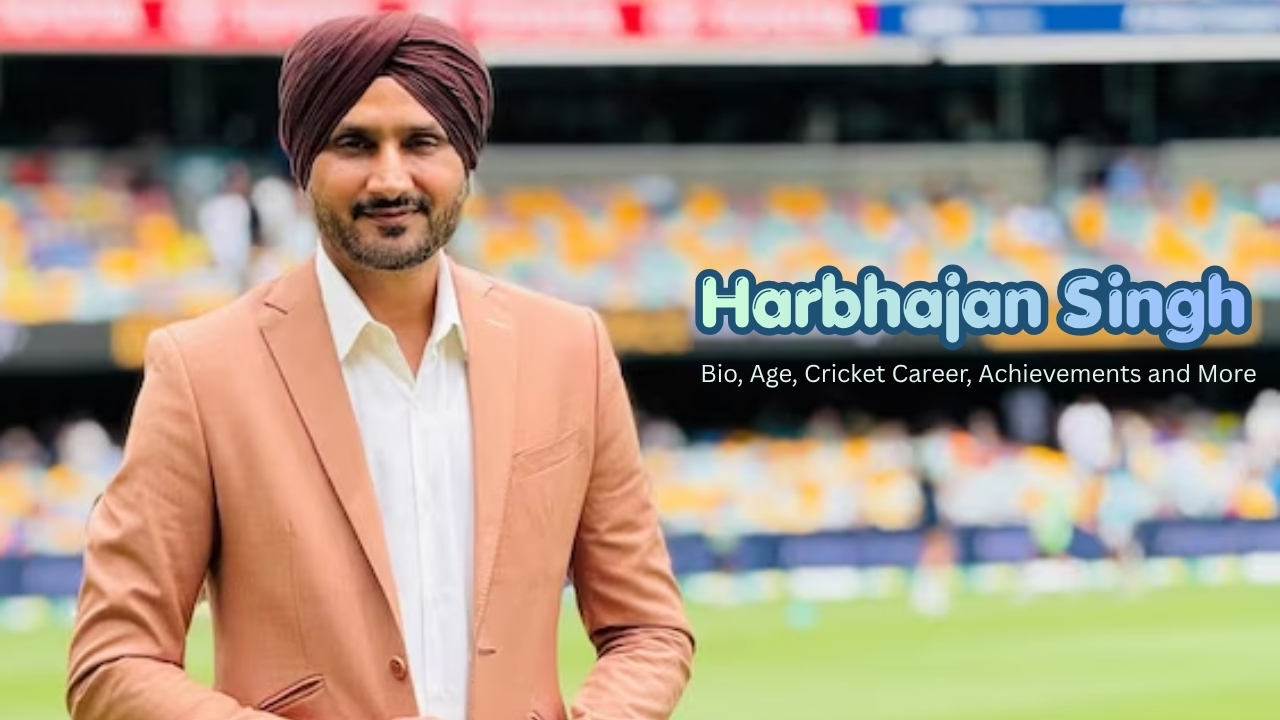
Harbhajan Singh, the ever-popular “Turbanator,” is an important part of India cricket history as one of India’s greatest spin fraternity။ Harbhajan became popular for his deadly off-spin bowling, aggressive mindset and all-important performances to make India a power in world cricket during the early 2000s. He went on to establish his credentials as one of the most successful off-spinners in international cricket – over a more than 10-year career he became a two-time World Cup winner.
Biography Table of Harbhajan Singh
| Field | Details |
| Full Name | Harbhajan Singh Plaha |
| Nickname | Turbanator, Bhajji |
| Date of Birth | July 3, 1980 |
| Birthplace | Jalandhar, Punjab, India |
| Nationality | Indian |
| Profession | Former Cricketer (Off-Spinner) |
| Role | Bowler (Right-arm off-spin) |
| Batting Style | Right-handed |
| Bowling Style | Right-arm off-break |
| International Debut | 1998 (Test & ODI) |
| Retirement | 2021 (All formats) |
| Major Teams | India, Punjab, Mumbai Indians, Chennai Super Kings, Kolkata Knight Riders |
| Marital Status | Married |
| Spouse | Geeta Basra |
Harbhajan Singh Age
As of 2026, Harbhajan Singh is 45 years old. Born on July 3, 1980, he enjoyed a long and successful cricket career spanning over two decades, representing India at the highest level and continuing to contribute to the sport even after retirement.
Harbhajan Singh Physical Stats
| Attribute | Details |
| Height | Approx. 5 feet 11 inches (180 cm) |
| Weight | Approx. 75 kg |
| Eye Color | Dark Brown |
| Hair Color | Black |
| Body Type | Athletic |
| Fitness Level | High (maintained during playing career) |
The former India spinner had a robust and athletic physique, which allowed him to bowl long spells with both consistency and intensity. Fitness was a major component for sustaining performance across formats, particularly in Test cricket where it is often about durability.
Early Life and Background
Harbhajan SinghDate of Birth: 3 July 1980Birthplace: Jalandhar, Punjab, India He was the one out of six siblings born, and grew up in a Sikh family. ICL was the initial stumbling block for himAfter dreaming to become a fast bowler, but on the advice of his coaches and stature, he turned into an off-spinner and that also with all due credit shaped up his career.
Born in a humble family, Harbhajan started off with many economic hardships. He even thought about abandoning cricket to help his family after the death of his dad. But that determination and his talent kept him driven, and he carried on with the pursuit of tennis.
Domestic Career and Ascent to Stardom
Harbhajan started his cricket career with the domestic side Punjab. National selectors were quick to notice him, as his consistently impressive performances in domestic tournaments such as the Ranji Trophy attracted attention. However, what made him different from others spinners was his ability to extract sharp turn and bounce.
Somewhere in his late 1990s, he made his way to the Indian national team and that became a turning point in his career. While his earlier international outings were hit-and-miss, he showed occasional moments of brilliance that indicated what he might go on to become.
Bowling Statistics of Harbhajan Singh
| Format | Matches | Innings | Wickets | Best Bowling | Average | Economy | 5W Haul |
| Test | 103 | 190 | 417 | 8/84 | 32.46 | 2.84 | 25 |
| ODI | 236 | 225 | 269 | 5/31 | 33.35 | 4.31 | 3 |
| T20I | 28 | 28 | 25 | 4/12 | 25.32 | 6.20 | 0 |
The legacy of Harbhajan Singh is built on the back of the high-octane bowling career His right-arm off-spin incorporated classic spin permutations with contemporary variations to unsettle the world’s best batsmen.
Key Bowling Stats:
- Test Matches: 103
- Test Wickets: 417
- ODIs: 236 matches, 269 wickets
- T20Is: 28 matches, 25 wickets
He is also one of only a handful of bowlers in the history of cricket to have taken 400 Test wickets, and he joins an exclusive club of spin greats.
Bowling Strengths:
- Great turn and bounce on sub-continent pitches
- Mastery of the “doosra” delivery
- Must have more than just precision and control but the ability to bowl long, economical spells as well
- Aggressive approach that pressured batsmen
Especially at home venues, his control and variations rendered him virtually impossible to play against on it.
Batting Statistics of Harbhajan Singh
| Format | Matches | Innings | Runs | Highest Score | Average | 100s | 50s |
| Test | 103 | 145 | 2,224 | 115 | 18.22 | 2 | 9 |
| ODI | 236 | 128 | 1,237 | 49 | 13.08 | 0 | 0 |
| T20I | 28 | 6 | 108 | 33* | 27.00 | 0 | 0 |
Despite being remembered mainly as a bowler, he made his contributions with the bat too. It was this fighting spirit of his which frequently helped India come back from tough situations.
Batting Highlights:
- More than 2,200 runs in Test cricket
- Scored 2 Test centuries
- Known for aggressive lower-order batting
His stand-out batting might be the two back-to-back centuries in the 2010 Test series against New Zealand that proved his worth as an all-rounder.
He was an attacking batter and that added a lot of strength at the top of their order, taking on bowlers.
Harbhajan Singh Jersey Number
Harbhajan Singh, the former Indian wicket-thief is a household figure in cricketing circles for donning jersey no. 3 on his back during his international duties with India. He donned this number in ODIs and T20s, and it became synonymous with his on-field identity. He also donned number 3 for the Mumbai Indians in IPL over multiple seasons. He was also noticed wearing jersey no. 27 in a few matches during his stint with Chennai Super Kings and Kolkata Knight Riders later on. His jersey number still lives on amongst cricket fans due to his long career, that saw him claim over 700 international wickets and win major ICC tournaments with India.
International Career Highlights
Here is how Harbhajan Singh delivered in some of the big events and tours:
- A massive contribution for India’s victory in the 2007 ICC T20 World Cup
- Part of the 2011 ICC Cricket World Cup winning squad
- Played instrumental part in Test series victories over top teams such as Australia
The fact that he was able to perform in high-pressure games made him a reliable match-winner.
International debut and early career struggles
Harbhajan Singh played Test and ODI cricket from 1998 to the time when he had officially announced his retirement. He had to fight hard for his spot in that squad, with a certain Anil Kumble pretty firmly established as the team’s premier spinner. He was, at times, left out right upto the squad which again was a test of his character.
However, Harbhajan never gave up. The variations he worked on, particularly his doosra, were what did the trick against unsuspecting batsmen. His persistence eventually led to receiving another chance to demonstrate just that.
Historic 2001 Border-Gavaskar Trophy
It was the 2001 Test series v Australia that proved a career turning point for Harbhajan Singh. It is one of the most revered comebacks in history of cricket.
Harbhajan was simply phenomenal, bagging 32 wickets in three Tests including the first-ever hat-trick by an Indian in Tests.
It was his match winning spells that led to India defeating then world number one Australia and propelled him to become the chief spin bowler of India. It was not only a career resurrection for this series, but also made him a national icon.
Peak Years and International Success
Following his success in 2001, Harbhajan became a regular member of the Indian team. During his peak years, he was the backbone of India’s spin attack and played a vital role in many historic victories.
Test Cricket Achievements
- Played 103 Test matches
- Took 417 wickets, making him one of India’s highest wicket-takers
- Known for his ability to perform exceptionally well on Indian pitches
ODI Career Highlights
- Played 236 ODIs
- Claimed 269 wickets
- Played a key role in several series wins
T20 International Career
- Played 28 T20Is
- Took 25 wickets
Harbhajan was known not only for his bowling but also for his fighting spirit with the bat. He scored over 2,000 Test runs, including two centuries, showcasing his all-round abilities.
Role in World Cup Victories
Here are some of the more salient points in Harbhajan Singh’s career.
- 2007 ICC T20 World Cup – An astute contributor India to its first T20 World Cup victory
- 2011 ICC Cricket World Cup – Member of the squad which won the World Cup on home soil
These feats enshrined his name in the lore of one of India’s great match-winners
Indian Premier League (IPL) Career
He too was quite big name in IPL. He has played for numerous franchises, most infamously:
- Mumbai Indians
- Chennai Super Kings
- Kolkata Knight Riders
IPL Achievements:
- Leading wicket taker in the tournament
- Three IPL trophies with Mumbai Indians
- Formerly led Mumbai Indians in early years
He proved to be an asset in franchise both because of his experience and leadership.
Playing Style and Strengths
The off-spinner of his time was therefore a conventional off-spinner with modern appeal. His key strengths included:
- Doosra: A delivery that would spin in the other direction
- Attacking mentality: Cagey never to go after batsmen
- Consistency: Capacity to throw lengthy spells with control
- Match awareness: Strong situational awareness
The same can be said for his on-field energy; he was a passion player whose exuberance lifted the performances and spirits of everyone around him.
Controversies and Challenges
As is the case with most high-profile athletes, there were some controversies in Harbhajan Singh’s career. Perhaps the most publicised incident was “Monkeygate” during Andrew Symonds’ India tour of Australia in 2008.
S. Sreesanth’s involvement in an IPL “slapgate” incident in 2008 was another modern day controversy that saw a temporary suspension.
Harbhajan, who carried on playing for India and doing great things despite setbacks in his personal life over the years, whether they were defeats or internal battles.
Later Career and Retirement
Due to the presence of younger spinners like Ravichandran Ashwin, Harbhajan was unable to cement his place in the national team towards the end of his career. Slowly but surely, his spot in the national team was never guaranteed.
Internationally, he became almost extinct in his appearances after 2016 even though the domestic cricket and IPL have always seen him play on. He went on to announce his retirement from all forms of cricket, retiring a glorious career.
Life After Cricket
While Harbhajan Singh took retirement from cricket, he continued to be watching the game and living in public life.
- Became a cricket commentator and analyst
- Mentored young players and spinners
- Provided commentary and appeared in media debate formats related to cricket
His sphere extends beyond cricket and has been involved in social and political life.
Records and Achievements
Awards and achievements of Harbhajan Singh include:
- Fast bowler with Test hat-trick to his name
- 700-plus wickets in formats worldwide
- Two-time World Cup winner
- Among India’s most successful off-spinners
- Multiple IPL titles
His contribution to Indian cricket can not be forgotten.
Legacy and Impact
Harbhajan Singh is one of the finest spin bowlers India has produced. His performances, particularly from the beginning of last decade, were instrumental to making India a world class unit.
He encouraged a legion of spin bowlers to take up the art and showed that sheer through gritt can conquer all.
More Achievements in Cricket
Harbhajan Singh’s career is filled with numerous milestones and records:
- First Indian to take a Test hat-trick
- Over 700 international wickets across formats
- Among India’s top wicket-takers in Tests
- Played over a decade at the highest level
- Part of two World Cup-winning squads
- One of the most successful off-spinners in cricket history
His consistency and longevity highlight his greatness in the sport.
FAQs about Harbhajan Singh
1. Who is Harbhajan Singh?
Harbhajan Singh is a former Indian cricketer and one of the country’s greatest off-spin bowlers.
2. How many wickets did Harbhajan Singh take in international cricket?
He took over 700 international wickets across Test, ODI, and T20 formats.
3. What is Harbhajan Singh’s biggest achievement?
His historic hat-trick against Australia in 2001 and being part of two World Cup-winning teams are major highlights.
4. Did Harbhajan Singh score centuries in Test cricket?
Yes, he scored two Test centuries, proving his value as a lower-order batsman.
5. Which IPL teams did Harbhajan Singh play for?
He played for Mumbai Indians, Chennai Super Kings, and Kolkata Knight Riders.
6. When did Harbhajan Singh retire from cricket?
He officially retired from all forms of cricket in 2021.